
Why Dhaka traffic makes billboards work harder than almost anywhere
The thing everyone complains about is the thing that makes the medium work. A stationary audience at a signalled junction is worth more per second than a motorway doing sixty — and Dhaka produces that condition all day.
6 min read Industry
There is a slightly uncomfortable truth at the centre of out-of-home in this city, and it is worth saying plainly: our medium is subsidised by everybody else’s misery.
Nobody enjoys forty minutes at Mohakhali. But those forty minutes are, in media terms, extraordinary. Attention is the scarcest commodity in advertising, and Dhaka manufactures it by the hour.
Volume is the wrong metric
Buyers new to the medium ask for the busiest road. It is intuitive and it is wrong, because volume and attention are different things and they often point in opposite directions.
| Condition | Vehicles | Time in view | What lands |
|---|---|---|---|
| Fast arterial road | Very high | Under two seconds | A logo, at best |
| Signalled junction | Lower | Thirty seconds to two minutes | A logo, a line, and a second look |
| Flyover approach | High | Three to six seconds | A strong single idea |
| Market or bazaar road | Moderate, slow | Sustained, repeated | Detail, and genuine recall |
The same audience, two different conditions
A junction that queues gives you the one thing no other medium can guarantee: a person with nothing else to look at.
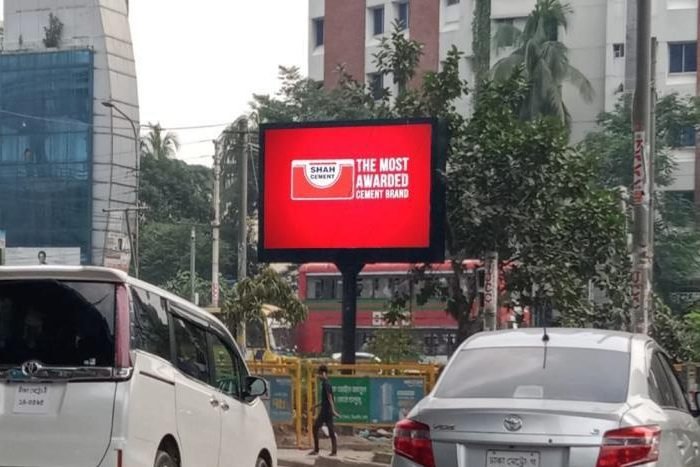
The angle matters as much as the address
Two screens can sit at the same junction and perform completely differently, because one faces the queue and the other faces the traffic already moving away. When we list a site as "facing Gulshan 2 and Mohakhali", that is not decoration — it tells you which flow of people has it in view, and for how long.
This is the single most common planning mistake I see. A brand books a famous junction, takes whichever face was free, and reaches the people leaving rather than the people arriving.
What this means for your creative
If you have genuinely bought dwell time, you can afford one more beat than the usual seven-word rule allows — a second line, a price, a location. Not a paragraph. But the standard advice, which is written for motorway media in countries where traffic moves, is slightly too austere for a Dhaka signal.
The sites behind this
Every screen has a page with a photograph, the size, the direction it faces and the hours it runs.
Questions this raises
Keep reading
- Industry What is changing in OOH Print is not dying, but it is being asked to do a narrower job. The shift to LED has changed how campaigns are bought, how quickly they can change, and — most usefully — what an advertiser can prove afterwards.
- Planning Advertising around Ramadan and Eid The busiest and strangest weeks in the Bangladeshi out-of-home calendar. Traffic patterns invert, demand spikes, and the brands that plan backwards from Chand Raat get the sites the rest are still asking about.
- Planning Buying beyond Dhaka Regional markets are usually planned last and bought worst. They are also, per taka of reach, the most efficient inventory in the country — and they behave nothing like a smaller Dhaka.