
Planning outdoor advertising around Ramadan and Eid in Bangladesh
The busiest and strangest weeks in the Bangladeshi out-of-home calendar. Traffic patterns invert, demand spikes, and the brands that plan backwards from Chand Raat get the sites the rest are still asking about.
7 min read Planning
If you only run one out-of-home campaign a year in Bangladesh, this is probably the window. It is also the one where the usual rules bend hardest, so it repays a bit of planning.
The traffic inverts, and most plans ignore it
For eleven months of the year the shape of a Dhaka day is familiar: a heavy morning peak, a grinding evening one. During Ramadan that changes. The morning softens. The pre-Iftar window becomes the most concentrated movement of the day — everybody trying to get somewhere before the call. And then, remarkably, the city comes back out afterwards, and stays out late.
A media plan built on ordinary commute assumptions will therefore put its weight in the wrong hours. On digital, that is a scheduling fix rather than a booking one — which is one of the strongest arguments for taking screens rather than print in this period.
| Window | Ordinary week | During Ramadan |
|---|---|---|
| Morning | Heaviest peak | Lighter, later start |
| Midday | Steady errands | Quiet |
| Pre-Iftar | Unremarkable | The densest movement of the day |
| Post-Iftar | Winding down | Second peak — social, retail, family |
| Late night | Thin | Substantial, especially the last ten days |
How a Ramadan day differs from an ordinary one
Book earlier than feels necessary
The best faces for this window are usually gone weeks before it opens. If you are ringing around in the second week of Ramadan you are choosing from what is left, and what is left is left for a reason.
My rule of thumb: have the sites confirmed before Ramadan begins, and have the artwork approved a week before that. It sounds early. It is the difference between the position you wanted and the position you settled for.
What to actually say
Two failure modes, both common. The first is generic goodwill: a greeting, a moon, a logo, nothing else. Warm, forgettable, indistinguishable from the nine other brands doing the same thing on the same road.
The second is the opposite — cramming a full retail offer into a moment when people are not shopping, they are commuting to break a fast.
- Pre-Iftar hours: immediacy. What is open, what is near, what can be collected on the way home.
- Post-Iftar and late: the softer work — family, gifting, the brand rather than the offer.
- The last ten days: shopping intent peaks. This is where a straight retail message earns its place.
- Chand Raat and Eid: greetings work, but only if the brand is unmistakably yours at a glance.
And the week after
Everybody stops on Eid. The city empties, then refills, and for about a week afterwards the roads are quieter and the screens are cheaper to hold. If your category has any post-Eid relevance — travel, home, electronics, anything bought with Eid money — that lull is quietly one of the better-value windows in the year.
The sites behind this
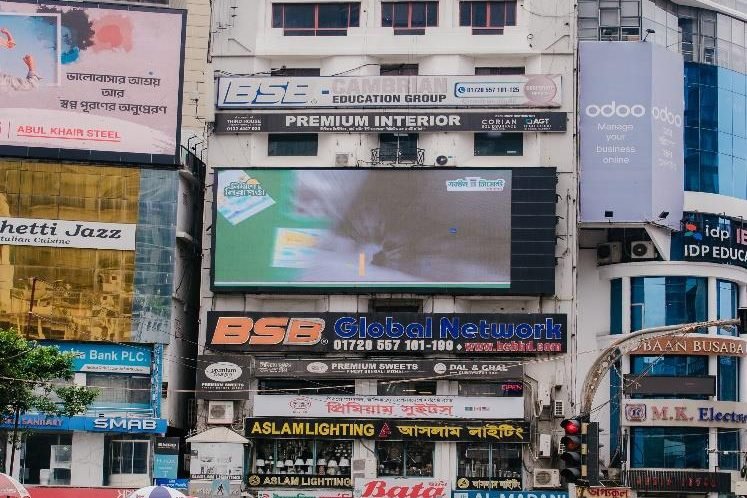
Every screen has a page with a photograph, the size, the direction it faces and the hours it runs.
Questions this raises
Keep reading
- Industry Dhaka traffic and dwell time The thing everyone complains about is the thing that makes the medium work. A stationary audience at a signalled junction is worth more per second than a motorway doing sixty — and Dhaka produces that condition all day.
- Sector guides OOH for FMCG brands Fast-moving consumer goods live or die on distribution and mental availability. Out-of-home is unusually good at the second and, in this market, quietly useful for the first.
- Industry What is changing in OOH Print is not dying, but it is being asked to do a narrower job. The shift to LED has changed how campaigns are bought, how quickly they can change, and — most usefully — what an advertiser can prove afterwards.