
Beyond Dhaka: buying out-of-home in Bangladesh’s regional cities
Regional markets are usually planned last and bought worst. They are also, per taka of reach, the most efficient inventory in the country — and they behave nothing like a smaller Dhaka.
6 min read Planning
A familiar sequence: the Dhaka plan is built, refined and signed off, and then somebody asks what we are doing regionally. There is a fortnight left and whatever is available gets taken.
Which is a shame, because regional inventory is where the arithmetic is friendliest.
The efficiency argument
Dhaka is so large that one screen reaches a slice of it. A regional city concentrates its movement through a handful of central points, so a single well-chosen face covers a genuinely large share of the population that matters to you.
If your metric is reach per taka rather than absolute impressions, the regions win, often comfortably.
They are not small Dhakas
Each market has a rhythm of its own, and treating them as interchangeable is where regional plans go wrong.
- Chattogram is a port and an industrial economy. Its traffic is commercial as much as commuter, and the station approaches carry a different audience from the circles.
- Sylhet swells with the diaspora calendar. Hospitality, jewellery, property and travel move with it.
- Cox’s Bazar is almost purely seasonal. Book around the tourist season rather than the financial quarter.
- Rajshahi is education-led, with a young population and an academic calendar to match.
- Rangpur, Bogura and Cumilla are regional hubs — the centre of gravity for a wide rural catchment, which is more people than the city population suggests.
- Narayanganj is effectively an industrial extension of Dhaka, with its own dense local movement.
How to sequence a national plan
- Decide the regional markets first, not last — they are the constraint, because there are fewer good faces in each.
- Book them early. In a city with two or three strong positions, "available" disappears fast.
- Use one adaptable artwork. Regional formats are more uniform than Dhaka’s, so one file usually travels without a redraw per face.
- Hold them longer. Frequency does even more work where a single face is most of the coverage.
The sites behind this
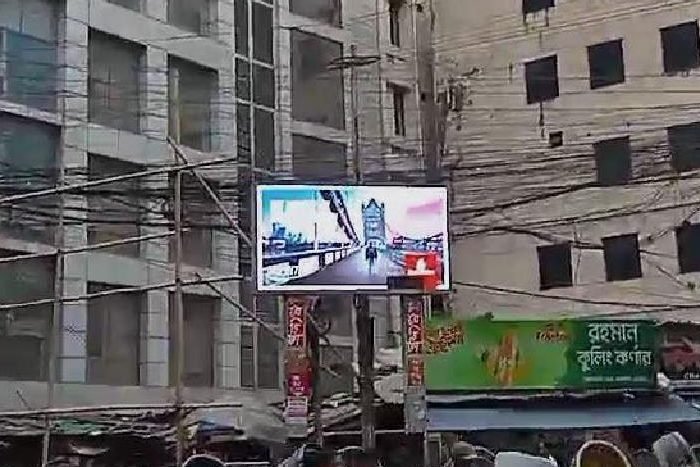
Every screen has a page with a photograph, the size, the direction it faces and the hours it runs.
Questions this raises
Keep reading
- Sector guides OOH for FMCG brands Fast-moving consumer goods live or die on distribution and mental availability. Out-of-home is unusually good at the second and, in this market, quietly useful for the first.
- Industry Dhaka traffic and dwell time The thing everyone complains about is the thing that makes the medium work. A stationary audience at a signalled junction is worth more per second than a motorway doing sixty — and Dhaka produces that condition all day.
- Industry What is changing in OOH Print is not dying, but it is being asked to do a narrower job. The shift to LED has changed how campaigns are bought, how quickly they can change, and — most usefully — what an advertiser can prove afterwards.